
Table of Contents
- Define Your Mission Before Choosing Durable Tactical Gear
- Best Tactical Gear Materials for Long-Term Durability
- Military-Spec vs Civilian Gear: What Actually Matters
- Critical Features That Signal Quality Tactical Gear
- Tactical Gear Maintenance Tips for Extended Lifespan
- Testing Durability Before You Commit
- Repairability vs Replaceability: The Long-Term Decision
- Frequently Asked Questions
Define Your Mission Before Choosing Durable Tactical Gear
Choosing durable tactical gear starts with a single question: what's the actual job this gear needs to do? Too many people buy tactical equipment based on aesthetics or brand reputation without clarity on their specific use case. That's where most purchases go wrong.
Your mission determines everything. A weekend hiker needs different durability standards than someone deploying gear for extended field operations. A casual outdoor enthusiast might prioritize comfort and weight distribution, while a professional operator focuses on load-bearing capacity and stress-point reinforcement. These aren't minor distinctions, they fundamentally change which materials, attachment systems, and construction methods matter most.
Define your mission first: Are you managing daily carry for urban environments? Extended backcountry trips? Professional tactical deployment? Each scenario demands different durability priorities.
Start by listing the specific activities you'll perform with this gear. How many hours per day will you wear it? What environmental conditions will you face? Will you be climbing, rappelling, moving through dense terrain, or primarily stationary? What weight load will you regularly carry? These answers eliminate confusion and point you directly toward the right gear category.
Best Tactical Gear Materials for Long-Term Durability
Material selection is where durability is actually built or lost. The wrong fabric choice can make even well-constructed gear fail within months. The right materials, combined with proper construction, can deliver years of reliable performance.
Ripstop Nylon and Cordura Fabrics
Ripstop nylon remains the industry standard for tactical applications because it solves a specific problem: traditional nylon tears catastrophically when punctured. Ripstop's woven grid structure contains tears, when a puncture occurs, the tear stops at the nearest grid line instead of propagating across the entire panel.
Cordura, a branded high-tenacity nylon, takes durability further. It offers superior abrasion resistance compared to standard ripstop, making it the preferred choice for areas that experience constant friction: pack bottoms, shoulder straps, and external attachment points. Many professional-grade tactical packs use Cordura on high-wear surfaces and ripstop on lower-stress panels, a cost-effective approach that extends overall lifespan.
The denier rating matters significantly. A 500-denier fabric is lighter but less durable than 1000-denier. For mission-critical gear, 1000-denier or higher is the practical minimum. The trade-off is weight, heavier fabrics add ounces. But for load-bearing applications where durability is non-negotiable, that weight penalty is worth the extended service life.
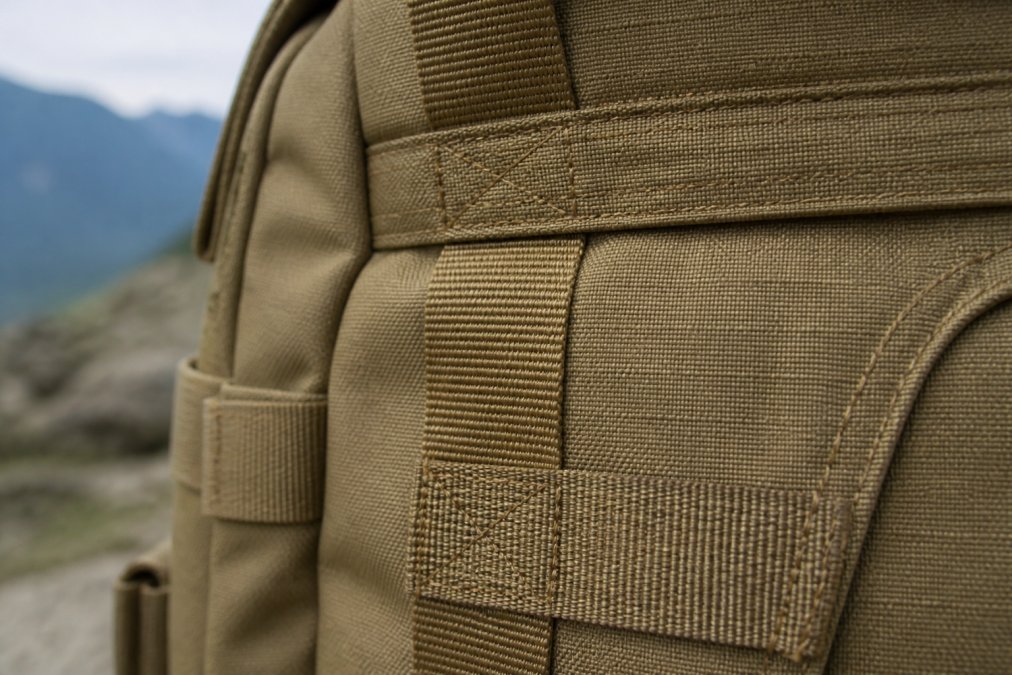
Look for fabric that's been treated with water-resistant coatings. Silicone or polyurethane coatings add weatherproofing without significantly increasing weight. These coatings also reduce the fabric's tendency to absorb water, which can add 20-30% to the pack's weight during extended field operations (peer-reviewed research).
Reinforced Stitching and Stress Point Construction
Fabric quality means nothing if the stitching fails. This is where many budget tactical products cut corners, and where they fall apart.
Military-specification (MIL-SPEC) stitching standards exist for a reason. They define thread type, stitch density, and reinforcement patterns that actually survive repeated stress cycles. A typical MIL-SPEC seam uses thread with higher tensile strength than consumer-grade options and maintains 4-6 stitches per inch on primary load-bearing seams.
Bar-tacking, the dense cross-stitching pattern used at corners, attachment points, and stress concentrations, is what separates field-ready gear from equipment that fails under load. A properly bar-tacked corner can withstand thousands of load cycles (nist.gov). Without it, seams separate within months.
Examine the stitching on potential purchases. Look for:
- Double or triple-stitched seams on all primary load-bearing areas
- Bar-tacking at every corner and attachment point
- Thread color that matches the fabric (a sign of intentional construction, not an afterthought)
- Consistent stitch length with no loose or skipped stitches
The 42L Tactical Backpack Bag with USA Patch from Gear Up & Go features reinforced stitching at all stress points and uses high-quality brand zips that won't fail under repeated use. This construction method adds durability.

Military-Spec vs Civilian Gear: What Actually Matters
The term "military-spec" gets overused in marketing. Not every product claiming MIL-SPEC compliance actually meets those standards. Understanding what military specifications actually require helps you evaluate whether a product genuinely delivers that durability.
Military specifications define measurable performance standards: tear resistance, seam strength, water penetration rates, and environmental durability under specific test conditions. A gear item claiming MIL-SPEC compliance should be able to demonstrate test results. If a manufacturer can't provide documentation, the claim is marketing noise.
Civilian-grade tactical gear often adopts military construction principles without full MIL-SPEC certification. This can be perfectly adequate depending on your mission. A weekend hiker doesn't need equipment rated for multi-month field deployment in harsh environments. The weight and cost penalties of full MIL-SPEC compliance may be unnecessary.
The practical distinction: MIL-SPEC gear is engineered for extended, high-stress use in extreme conditions. It prioritizes durability and reliability over weight and cost. Civilian tactical gear balances durability with practicality for recreational and semi-professional use. Neither is inherently "better", the right choice depends on how hard you'll actually push the equipment.
Look for manufacturers who specify their testing methodology. Have they conducted accelerated wear testing? Drop testing? Load cycling? Transparency about durability validation signals genuine engineering rather than marketing claims.
Critical Features That Signal Quality Tactical Gear
Beyond materials and stitching, specific design features indicate whether gear is built to last or engineered for planned obsolescence.
MOLLE System and Modular Attachment Points
The MOLLE (Modular Lightweight Load-carrying Equipment) system and its civilian equivalent, PALS (Pouch Attachment Ladder System) webbing, fundamentally change how gear functions. Instead of fixed compartments, MOLLE webbing allows modular attachment of pouches, tools, and accessories.
This isn't just convenience, it's durability engineering. Modular systems distribute stress across multiple attachment points instead of concentrating load on fixed seams. A pouch attached via MOLLE webbing can be repositioned or removed without degrading the primary pack structure. Fixed pouches, once torn from repeated loading, can't be easily repaired or replaced.
Quality MOLLE implementation uses mil-spec webbing (typically 1.75 inches wide) with consistent ladder spacing. The webbing should be sewn with multiple rows of stitching, not just edge-stitched. Examine how the webbing is attached to the pack body, it should be fully enclosed in the seam, not surface-applied.
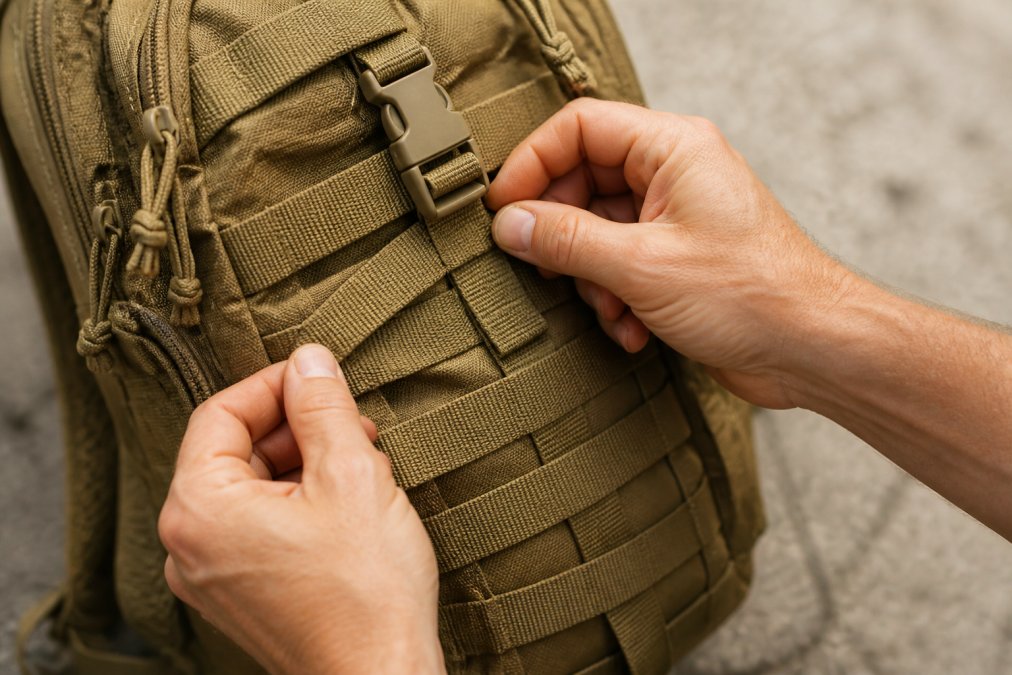
Quick-release buckles (also called ladder-locks or side-release buckles) are the standard for MOLLE attachment. These allow one-handed adjustment and quick repositioning of gear. Look for polymer hardware that's reinforced at stress points, cheap plastic buckles crack under repeated use.
Weight-to-Durability Balance and Ergonomic Fit
The best durable gear is gear you'll actually use. Overbuilt equipment that's too heavy for your mission gets left behind, defeating the entire purpose of having it.
Weight distribution matters as much as total weight. A pack with proper load-bearing straps, sternum straps, and hip belts distributes weight across your body's strongest structures, hips and shoulders, instead of concentrating it on your shoulders alone. This reduces fatigue and allows you to carry heavier loads comfortably. Ergonomic fit also reduces the repetitive stress that damages gear through constant shifting and readjustment.
Adjustable compression straps serve dual purposes: they stabilize your load (reducing movement that stresses seams) and allow you to customize the pack's profile for different load weights. Look for hook-and-loop (Velcro) compression straps that won't slip or come loose during use.
The relationship between weight and durability is straightforward: heavier materials are generally more durable. But there's an efficiency threshold. A pack that's 2 pounds heavier but distributes load more effectively might actually reduce overall stress on materials and seams compared to a lighter pack that causes postural strain.
Test fit before committing. Wear the pack loaded to your typical mission weight. Does it sit comfortably? Do the straps dig in? Does the weight feel distributed or concentrated? Ergonomic fit is a durability factor, poorly fitting gear fails faster because you're constantly adjusting it and your body is working harder against it.
Tactical Gear Maintenance Tips for Extended Lifespan
Durability isn't just about construction, it's about care. Proper maintenance extends the lifespan of even well-built gear by years.
Establish a post-mission cleaning routine. Dirt, sand, and salt accumulate in seams and attachment points, accelerating wear. A simple rinse with fresh water after each use removes abrasive particles. For salt water or mud exposure, use a soft brush to gently clean seams without forcing debris deeper into the fabric.
Allow gear to dry completely before storage. Moisture trapped in seams promotes mold growth and weakens thread over time. Hang packs upside down in a well-ventilated space, never store damp gear in a closed bag.
Inspect attachment points regularly. Check MOLLE webbing for loose stitching, examine buckles for cracks, and verify that all seams remain intact. Catching small damage early prevents catastrophic failure. A single loose stitch can be re-stitched in minutes; waiting until the entire seam separates requires professional repair or replacement.
For gear with zippers, apply a silicone-based lubricant to zipper tracks every few months. This prevents corrosion and binding. Avoid oil-based lubricants, which attract dirt and gum up mechanisms.
Store gear in a cool, dry location away from direct sunlight. UV exposure degrades synthetic fabrics over time. If your gear will be stored long-term, use breathable storage bags rather than sealed plastic containers, which trap moisture.
Testing Durability Before You Commit
Before making a significant gear investment, validate that the equipment will actually meet your durability needs.
If possible, rent or borrow similar gear for a trial mission. Use it under conditions matching your intended application. This reveals practical durability issues that specifications don't capture. Does the pack's weight distribution work for your body type? Do attachment points experience unexpected stress? Do seams show any signs of strain after real-world use?
Examine returned or used gear from reputable sellers. How do multi-year-old versions of the product hold up? Look at wear patterns: do they show stress at expected points (which is normal) or unexpected locations (which suggests design flaws)? Do seams remain intact or show separation? Are attachment points still functional?
Request durability documentation from manufacturers. Legitimate tactical gear companies conduct accelerated wear testing and can provide results. They test seams to failure, measure tear resistance, and validate water penetration rates. If a manufacturer won't share this data, that's a warning sign.
Read user reviews specifically for long-term durability reports. Avoid reviews from first-week users, they haven't tested the gear under real stress. Focus on feedback from people who've used the equipment for 1-2 years of regular missions. What fails first? What surprises them with durability?
Repairability vs Replaceability: The Long-Term Decision
Here's a question most gear guides skip: is this equipment designed to be repaired or replaced?
Repairability is a durability feature. Gear that can be field-repaired extends its lifespan indefinitely. A torn seam can be re-stitched. A broken zipper can be replaced. A damaged attachment point can be reinforced. This requires modular construction where components are accessible and replaceable.
Replaceability-focused design is the opposite: components are fused together, making repairs difficult or impossible. When something fails, you replace the entire item. This approach reduces initial cost but increases lifetime cost.
For mission-critical gear, repairability matters. A pack that can be field-repaired during an operation is infinitely more valuable than one that becomes non-functional at the first damage point. Modular construction, accessible seams, and replaceable components (zippers, buckles, webbing) enable repair.
Examine whether replacement parts are available. Can you buy new zippers, buckles, or webbing for a pack you own? Or would you need to replace the entire pack? Manufacturers that sell replacement components are signaling confidence in their durability and supporting long-term customer relationships.
Consider the cost-per-year-of-use metric. A pack that costs twice as much but lasts three times longer is actually cheaper. If you'll use gear for 5+ years, initial cost matters less than durability and repairability.
Choosing durable tactical gear requires understanding your specific mission, evaluating materials and construction methods honestly, and committing to proper maintenance. The 42L Tactical Backpack Bag with USA Patch from Gear Up & Go combines ripstop and reinforced construction with MOLLE system versatility and ergonomic load distribution. Start with clarity on your mission, verify construction quality through inspection and testing, and prioritize repairability. That approach eliminates buyer's remorse and ensures your investment delivers years of reliable performance.
Frequently Asked Questions
Q: What materials make tactical gear the most durable?
A: Ripstop nylon, Cordura, and reinforced synthetic fabrics with high tensile strength resist tearing and abrasion. Look for double-stitching, bar-tacking at stress points, and polymer hardware rather than cheap plastic. MIL-SPEC materials undergo rigorous durability testing to withstand field-ready conditions. The 42L Tactical Backpack Bag with USA Patch uses waterproof ripstop construction with reinforced zips and durable plastic hardware specifically designed for active movement and load-bearing.
Q: How can you tell if tactical gear is high quality versus cheap replicas?
A: Examine the stitching pattern, quality gear has consistent, tight stitches with reinforced bar-tacking at corners and attachment points. Check hardware for weight and finish; heavy-duty polymer and metal hardware lasts longer than thin plastic. Test the fabric for tensile strength by gently pulling seams. Review stress points where straps connect and where weight concentrates. Cheap replicas use single-stitching, flimsy zips, and thin fabrics that fail quickly. Real tactical gear has weatherproofing, reinforced compression straps, and ergonomic design that distributes weight evenly.
Q: What is the difference between military-spec and civilian tactical gear?
A: Military-spec gear meets strict MIL-SPEC standards for durability, weatherproofing, and field performance under extreme conditions. Civilian tactical gear offers similar durability and features but may not undergo identical testing protocols. Both can be field-ready and mission-specific, but military-spec typically costs more and includes features designed for combat load-bearing. For outdoor enthusiasts and weekend hikers, quality civilian tactical gear performs excellently. The choice depends on your actual use case, casual hiking requires less stringent specs than professional tactical operations.
Q: How should you maintain tactical gear to ensure it lasts longer?
A: Store gear in a cool, dry place away from direct sunlight to prevent material degradation. Clean zips and MOLLE webbing regularly to remove dirt and debris that cause wear. Inspect stitching and stress points monthly for early signs of failure. Air-dry wet gear completely before storage to prevent mold. For backpacks, empty all compartments and let them air out weekly. Avoid machine washing unless the manufacturer approves; hand-wash with mild soap instead. Replace worn zips and straps promptly rather than waiting for complete failure. Proper storage protocols extend gear lifespan by years.
This article was written using GrandRanker